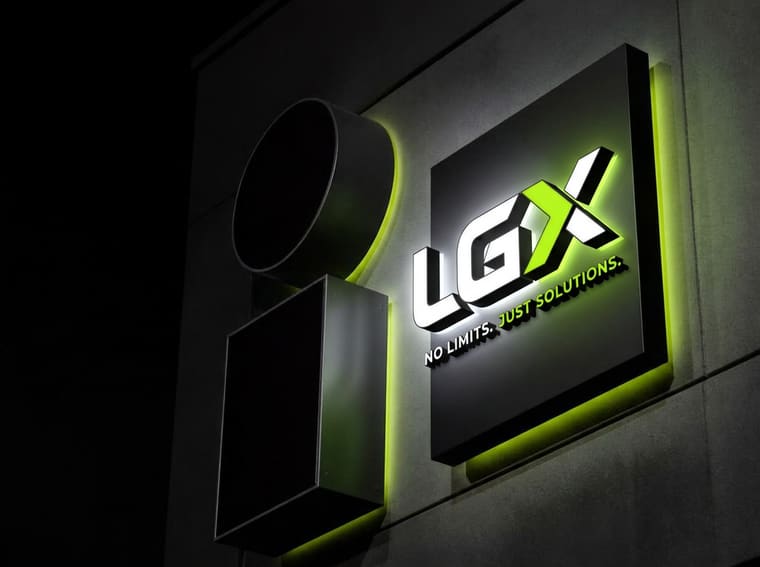
"What does a sign cost?" is one of the first questions we get on almost every call, and it's a fair one — but a straight dollar figure this early is usually a guess dressed up as an answer. Sign pricing swings on a handful of real variables, and once you know what they are, you can look at any quote (ours or anyone else's) and understand exactly what you're paying for.
The Factors That Actually Move the Price
- Sign type and structure. A set of window decals, a wall-mounted flat sign, illuminated channel letters, and a freestanding monument sign each require entirely different fabrication processes and materials.
- Size. Larger faces mean more substrate, more vinyl or paint, and in the case of channel letters, larger individual letterforms with more material and labor per letter.
- Illumination. Non-illuminated signage is the simplest to produce. Internally lit cabinet signs and channel letters add electrical components, wiring and, often, a licensed electrical hookup.
- Structure and mounting. A monument sign needs a foundation and structural engineering; a wall sign needs a mounting surface assessment; a raceway-mounted letter set needs the raceway itself.
- Permitting. Most municipalities require a sign permit for anything illuminated or over a certain size, and some require engineered drawings — that's a real line item, not paperwork overhead.
- Installation access. A wall sign at ground level installs very differently than one 30 feet up on a building face, which may call for a bucket truck or lift.
- Artwork complexity. A simple wordmark is faster to fabricate than a detailed multi-color logo with fine detail, especially in routed or dimensional letterforms.
Rough Cost Tiers, Without Fake Numbers
We're not going to publish made-up dollar figures here — real pricing depends on your specific building, code requirements and design, and anything else is just noise. What we can tell you honestly is the relative order of magnitude, from least to most investment for a typical single-tenant commercial building:
| Sign Type | Relative Cost Tier | Why |
|---|---|---|
| Window & wall vinyl graphics | Lowest | No structure, no illumination, fast install |
| Non-illuminated wall sign | Low–Moderate | Simple substrate and mount, no electrical |
| Illuminated cabinet sign | Moderate | Single enclosure, internal LEDs, electrical hookup |
| Illuminated channel letters | Moderate–High | Individually fabricated letters, per-letter LEDs |
| Monument / pylon sign | Highest | Foundation, structural engineering, often multi-tenant panels |
Placeholder — for you to review: if you want to publish actual starting price ranges for common sign types (e.g. "channel letters typically start around $X per linear foot of building frontage"), send us the real numbers and we'll add them here as a pricing guide. We're not inventing figures for this article.
Getting an Accurate Number
The fastest way to a real number is to send us:
- A photo of the building or wall where the sign will go.
- Your logo or brand file, if you have one.
- Any size constraints — a landlord's sign criteria, a maximum square footage, or a specific look you're trying to hit.
- Your timeline.
From there we can tell you what's realistic for your building and budget, including whether channel letters or a cabinet sign makes more sense for your situation. Request a quote and we'll walk you through it.
Common Questions
Is a quote free?
Yes. Send us photos, your logo, and what you're trying to accomplish, and we'll give you a straight answer on scope and cost before anything is ordered.
Does the quote include permitting?
In most cases, yes, for jobs in our service area — we'll tell you exactly what's included when we send your quote.
Why did two sign companies quote me very different prices?
Usually it's a scope difference, not just a price difference — different substrate quality, different illumination method, or one quote not including permitting or installation. Ask each company exactly what's included before comparing the numbers side by side.