Almost every storefront sign a customer asks us about falls into one of two families: individual illuminated channel letters mounted directly to the building, or a cabinet sign — a rectangular or shaped box with a printed or routed face, lit from inside. From the sidewalk they can look like a similar decision. Once you get into fabrication, code, and how the sign holds up over five or ten years, they're not close to the same product.
What Are Channel Letters?
Channel letters are individually fabricated letterforms — usually aluminum returns with an acrylic face — each with its own LED illumination, mounted directly to the wall or on a raceway. Because each letter is its own light source, the sign reads as bright, dimensional type rather than a lit rectangle. It's the look most people associate with a serious, established storefront: think of any national retailer or restaurant chain's building-mounted logo.
- Each letter is custom-fabricated to your logo's exact font and proportions — no stretching a stock typeface to fit a box.
- LED modules illuminate from within the letter (front-lit), from behind against the wall (halo-lit/reverse channel), or both.
- Mounted flush to the wall or on a raceway (a mounting bar that carries wiring, used when the wall surface isn't suitable for direct mount).
What Are Cabinet Signs?
A cabinet sign is a single enclosure — aluminum or a similar frame with a translucent acrylic or polycarbonate face — lit from inside by LEDs and displaying your logo and text as a printed or vinyl-applied graphic on that face. It's the format you see on most strip-mall tenant signage and pylon/monument sign panels, because it's efficient to produce at a range of sizes and works well when a sign has to fit a standard tenant panel or lease-defined footprint.
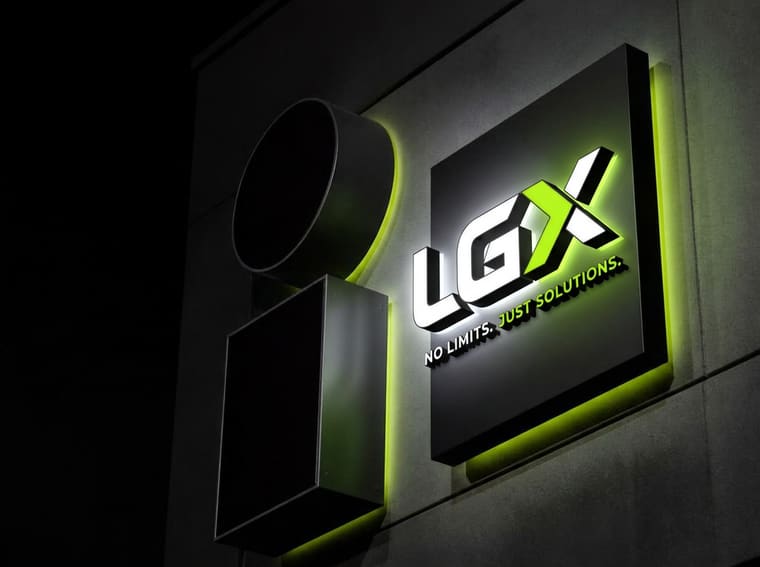
Side-by-Side
| Channel Letters | Cabinet Sign | |
|---|---|---|
| Look | Dimensional, individual letterforms | Flat, boxed graphic |
| Illumination | Per-letter LEDs; front-lit or halo-lit | Internally lit face, uniform glow |
| Night visibility | High contrast, reads as sharp type | Good, but can look like a lit rectangle at a distance |
| Typical cost tier | Higher — more fabrication per letter | Lower to moderate — single enclosure |
| Maintenance | Individual LED modules are simple to service | Face panel replacement if damaged or faded |
| Best for | Primary building signage, brand identity | Tenant panels, pylon signs, budget-driven projects |
Most municipalities and many landlords regulate sign type, size and illumination through a sign ordinance or a shopping center's sign criteria — before you fall in love with one option, it's worth confirming what's actually allowed on your building. This is one of the first things we check on a site survey.
Which One Fits Your Building?
A few questions tend to settle it quickly:
- Is this your primary building identification, or a tenant panel on a shared pylon sign? Shared structures usually dictate cabinet-style panels regardless of preference.
- Does your brand rely on a distinctive logotype or wordmark? Channel letters reproduce that exactly; a cabinet sign face can too, but won't read with the same dimensionality.
- What's the mounting surface? A textured stone or brick facade can complicate direct-mount channel letters and may call for a raceway or a different approach entirely.
- What's the budget and timeline? Cabinet signs are generally faster and less costly to produce; channel letters are a bigger investment that reads as one.
A sign is usually the first thing a customer sees, and often the last thing they remember.
Plenty of buildings end up using both — channel letters on the primary building face, and a cabinet-style panel on a shared road-front pylon sign. If you're not sure which applies to your situation, send us a photo of the building and, if you have it, your center's sign criteria — we'll tell you straight what's realistic. See our full signs and channel letter capabilities, or get a sense of what a project like this typically costs before you request a quote.
Common Questions
Can a cabinet sign be upgraded to channel letters later?
Sometimes, but it usually means a new structure or mounting solution rather than a simple swap — the wiring, mounting method and even the wall penetration points are different. It's worth deciding up front if you expect to outgrow a cabinet sign.
Are channel letters more expensive to run, not just to buy?
LED channel letters are efficient to operate — the ongoing electrical cost difference versus a cabinet sign is typically minor. The bigger cost difference is in fabrication, since each letter is its own component.
Do both types need a permit?
In most areas, yes — illuminated signage almost always requires a permit, and the process and requirements can differ by sign type. We handle the permitting for jobs in our service area, so this is one thing you don't have to untangle yourself.