"Which decoration method should we use" is a question with a real, specific answer once we know three things: how many pieces, what the design looks like, and how the garment gets worn. Screen printing, DTF and embroidery are all good at different jobs — the mistake is picking one before those three questions are answered.
The Three Methods
Screen Printing
Ink is pushed through a mesh screen, one screen per color, directly onto the garment. It's the most cost-effective method at real volume because the per-piece cost drops fast once the screens are made — but that screen setup is also why it has the highest minimums. Screen printing has a soft hand-feel when done well and holds color extremely well through washing.
DTF (Direct-to-Film)
Full-color art is printed onto a special film, then heat-pressed onto the garment. DTF has no minimum order in any meaningful sense — one shirt costs close to the same per-piece as fifty — and it handles complex, full-color, photographic-style artwork that would require many expensive screens to print traditionally. It's the fastest path from "I need this on a shirt tomorrow" to a finished garment.
Embroidery
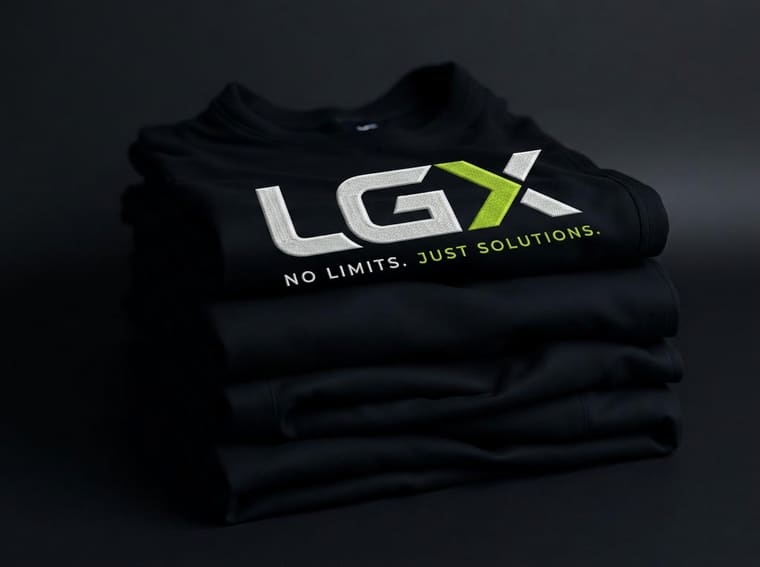
A design is stitched directly into the fabric with thread, digitized from artwork ahead of time. It's the most durable decoration method by a wide margin and the one that looks and feels the most "premium" on a garment — which is exactly why it's the standard for polos, hats and outerwear that get worn and washed constantly. It doesn't reproduce fine gradients or photographic detail the way print methods do; it works best with clean logos and lettering.
Comparison at a Glance
| Screen Printing | DTF | Embroidery | |
|---|---|---|---|
| Best for | Bulk orders, simple/spot-color art | Small runs, full-color/complex art | Uniforms, headwear, outerwear |
| Practical minimum | Higher (cost-effective in bulk) | None — works for one piece | None, but setup cost per design |
| Durability | Very good | Good | Excellent |
| Feel on garment | Soft when done well | Slightly heavier than screen print | Textured/raised, no "feel" issue since it's thread |
| Color complexity | Best with limited spot colors | Handles full color and gradients | Best with clean logos, limited detail |
| Fabric flexibility | Cotton and cotton blends ideal | Works on most fabric types | Works on most fabric types, best on stable weave |
A quick way to think about it: screen printing for the team event shirt order of 100+, DTF for the one-off or the design with a photo or gradient in it, embroidery for anything that lives on a person's body five days a week — polos, jackets, hats.
How to Choose for Your Order
- Start with quantity. Under roughly a dozen pieces, screen printing rarely makes financial sense — DTF or embroidery will usually be more cost-effective.
- Look at the art. Photographic detail or a gradient logo points toward DTF; a clean one- or two-color logo works well in any method, including the most durable one, embroidery.
- Consider how it'll be worn. Daily-wear uniform pieces earn back embroidery's higher per-piece cost through durability. A one-time event shirt doesn't need to survive 200 washes.
- Ask about reorders. If this is the first order of an ongoing program, see ${link} below on setting one up without it becoming a management headache.
The right method is the one that matches how the shirt actually gets worn — not the one that looks best in a mockup.
If you're setting up an ongoing uniform or team apparel program rather than a one-time order, that's its own set of decisions — see how to build a uniform program without managing hundreds of individual orders. Or tell us your piece count, fabric, and artwork and we'll recommend the method — see our full apparel and decoration capabilities.
Common Questions
Can I mix decoration methods in one order?
Yes — it's common to embroider polos and hats while screen printing or DTF-ing t-shirts within the same program, matched to how each piece will be worn.
Is DTF as durable as screen printing?
It's good, and has improved a lot as a process, but screen printing still generally edges it out for long-term wash durability at scale. For smaller runs or complex art, DTF is usually still the better overall choice.
What's the minimum for embroidery?
There's technically no garment minimum, but each new design has a one-time digitizing cost to convert artwork into a stitch file — after that, single pieces or large runs both work.